
Rules
How to Play
Conquest is easy in Battle for Burma. Legitimacy is the hard part — and it’s legitimacy, not territory, that decides how your game ends.
Setup
- 1
The dealer chooses one matching set of Army & Capital (HQ) cards per player, color-coded, and places them face down in pairs. Oldest to youngest players choose their set — the dealer chooses last. This HQ stays yours for the rest of the game.
- 2
Every player places their first Militia troop in their HQ district.
- 3
The dealer flips over 3 Mission cards and places them on the board.
- 4
Each player reads their army and HQ cards aloud.
- 5
While taking turns reading, every player takes 2 gems, 4 jade, 8 oil, gold, teak, and minerals.
- 6
Each army places 9 additional Sergeants and 11 Militia into Training, held off the board for now.
- 7
Starting with the oldest player, place one troop from Training per turn in clockwise rotation — one district at a time, back and forth, until every district on the board has an owner. A district active on one of the 3 Mission cards is worth grabbing even ahead of finishing your own home region — completing a Mission card is one of the biggest levers in the game.
- 8
Recruiting and district resources begin from the second round on.
- 9
Holding more than 10 troop value in a district requires a Lieutenant posted there too.
Combat
- 1
Place the district cards face up on the map and declare — by name — what district is attacking what district.
- 2
Pay 1 oil and 1 jade (or 2 gold) per 10 troops fighting, plus 1 more oil for every 5 additional troops or fraction of. You only pay again if you attack to or from a new district.
- 3
Attack with the wood dice: one die per soldier, up to 5. Defend with the jade dice: one fewer die than the attacker, or the number of troops in the district — whichever is less.
- 4
Line up the dice high to low and count the losses. Tied rolls go to the defender.
- 5
Repeat until you're out of soldiers or resources.
- 6
Lose to your last troop and the district is left empty — any adjacent army can move troops in during Transfer troops (the normal movement cost still applies, just no combat). Win, and you must advance at least one troop into it by the end of your turn.
- 7
Roll the IDP die immediately after every successful takeover.
- 8
Overtaking a non-allied HQ places a 'hostage' figure in the fallen capital. The losing army has 2 rounds to retake it before losing the hostage — and every troop there — for good. Meanwhile you choose: Liberate (half the captured resources go to social services, +5 statehood points/round) or Pillage (2x resources, but -5 statehood points/round, and you're locked out of ever ending as a Liberator or Occupier).
Drone and sea attacks work outside normal adjacency — drones can strike up to 3 districts away for 1 oil once you’ve bought one (4 gold) and trained a pilot; sea attacks move troops to or from any coastal district for a flat 2 oil per 10 troops, with a pre-emptive defensive roll against the crossing itself.
Resources
| Resource | Used for |
|---|---|
| Teak | Trains troops. Feeds POW camps. |
| Gold | Fuels attacks. Supports IDP camps. Weapons deals (2 gold each). |
| Oil | Fuels attacks, troop transport, and drone warfare. |
| Gems | Funds public works projects. 2 gems buys 5 statehood points. |
| Jade | Fuels attacks. Trains drone pilots. Propaganda concerts. Police Reserve (1 jade + 5 statehood points per officer, max 5 per army). Drawn blind from a bag in 3 grades — emperor green, jade green, faded green — only the color tells you the value. |
| Minerals | Supports widows after casualties. Trade. Statehood points. |
Buildings
IDP Camp
Holds 10,000 IDPs. Costs 3 gold per round. If it falls: the attacker loses 10 statehood points, the defender loses 5 plus 2 troops out of battle for a round, and pays 5 gold to rebuild it somewhere safe.
POW Camp
1 captured troop becomes 1,000 POWs. Costs 1 wood per 3 POWs per round, guarded 1 militia per 3 POWs held — double if you've neglected them before. Fall short on guards and the POWs escape, killing half their guards on the way out.
HQ Flag / Hostage
Marks your capital at game start. If your HQ falls, the flag becomes a hostage piece — you have 2 rounds to retake it before losing it, and every troop there, for good.
Hospital
8 gold to open, 4 gold per round. +5 statehood points per round. The first troop lost in each battle, defensively, recovers here free after 1 round — doesn't count as a casualty. Needs 25+ statehood points to start.
University
12 gold to open, 3 gold per round. +10 statehood points per round. Every round, one Militia leaving bootcamp is promoted straight to Lieutenant. Needs 50+ statehood points to start.
Officer Cadet School
6 gold to open, 1 gold per round. Two free troop upgrades every round (weapons excluded). +5 statehood points per round. Needs 25+ statehood points; may be placed in your HQ.
Training & upgrades
A Militia becomes a Sergeant for 1 wood, a Sergeant becomes a Lieutenant for 1 gold, and a Lieutenant becomes a Drone Pilot for 1 jade — each sent away to train immediately and returning several turns later (longer for the more senior upgrades), not instantly.
Troop values
The long game
The statehood ladder
Territory earns you the right to try. Statehood points are what actually move you up the ladder — each stage grants a standing bonus, and the top of the ladder is the game’s real win condition.
How it can end
Conquest without legitimacy has its own ending. Every army still standing when the game ends gets a card of its own — ten in total — and which one depends less on how much of the map you hold than on how you held it.
The game ends
when one army (or a 2-army ceasefire alliance) controls all of Burma, or the moment any army reaches The New Nation. Every army still standing then receives an Ending Card.
Your capital held
Which of these four you get depends on statehood points and a clean — or not so clean — record.
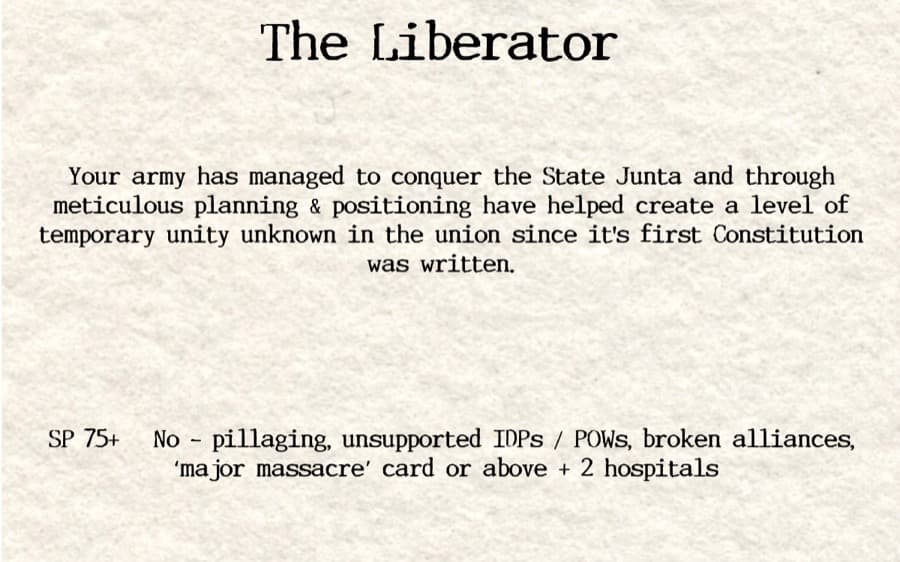
Liberator
SP 75+ · no pillaging · no unsupported IDPs/POWs · no broken alliances · no 'major massacre' card or above · a hospital
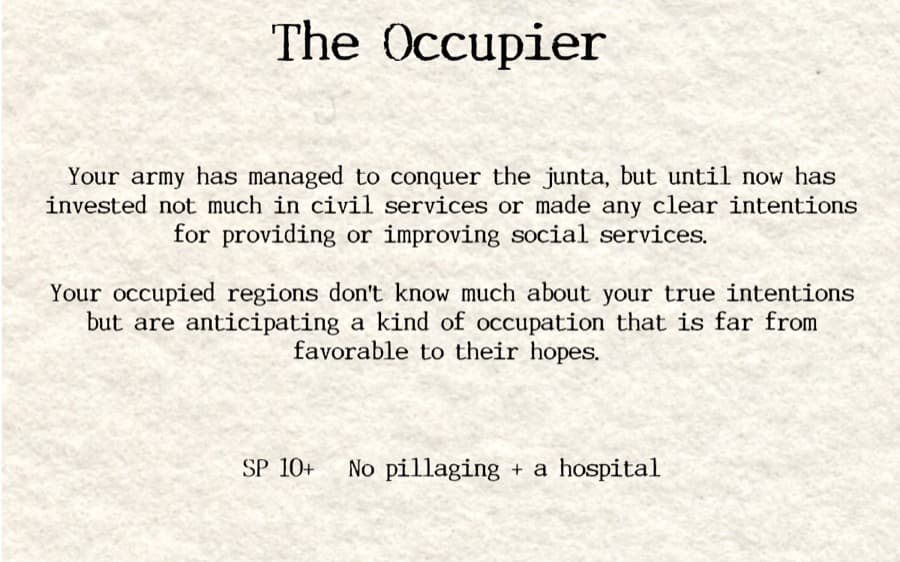
Occupier
SP 50+ · no pillaging · a hospital
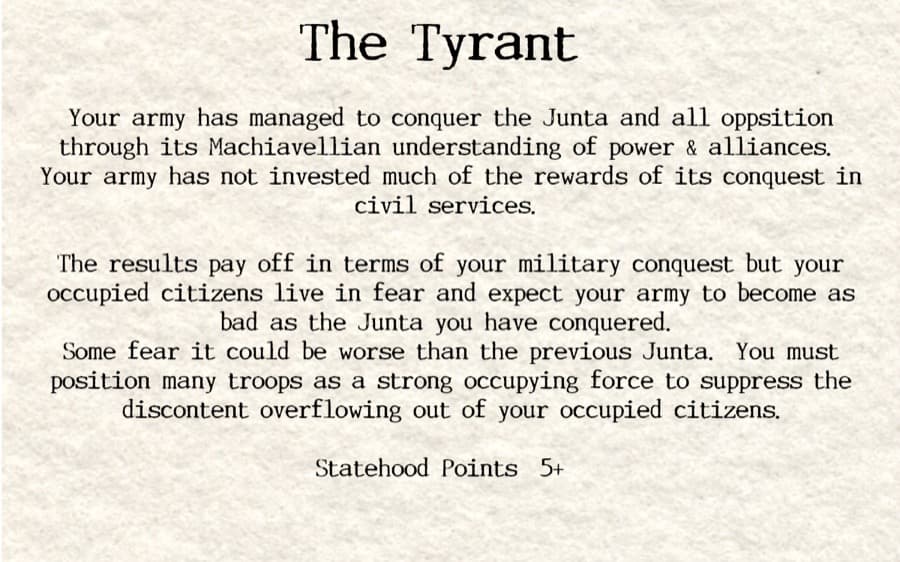
Tyrant
SP 25+
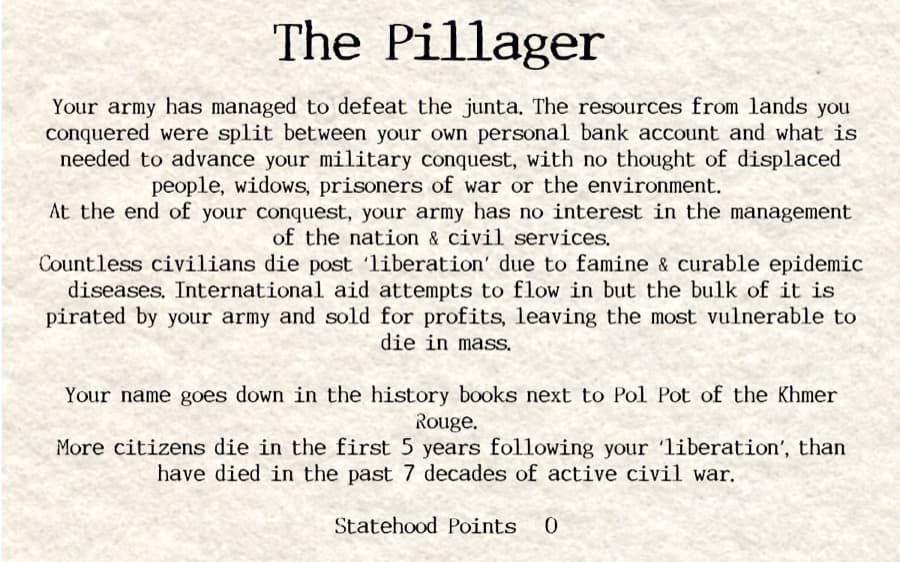
Pillager
SP 0 — resources looted from conquered capitals, no investment in the people who lived there
Your capital occupied
You get “Occupied by a —”, mirroring whichever of the four endings above your occupier ends up with.
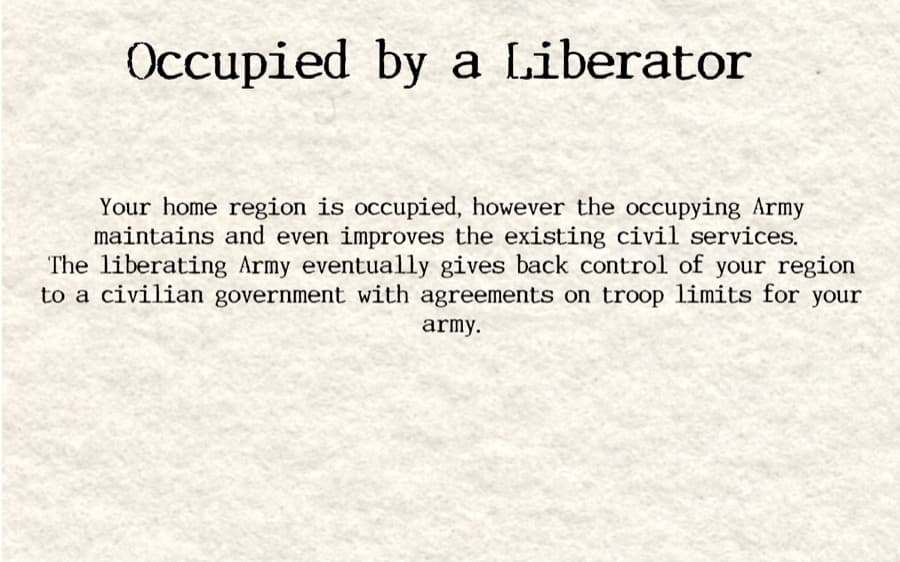
Occupied by a Liberator
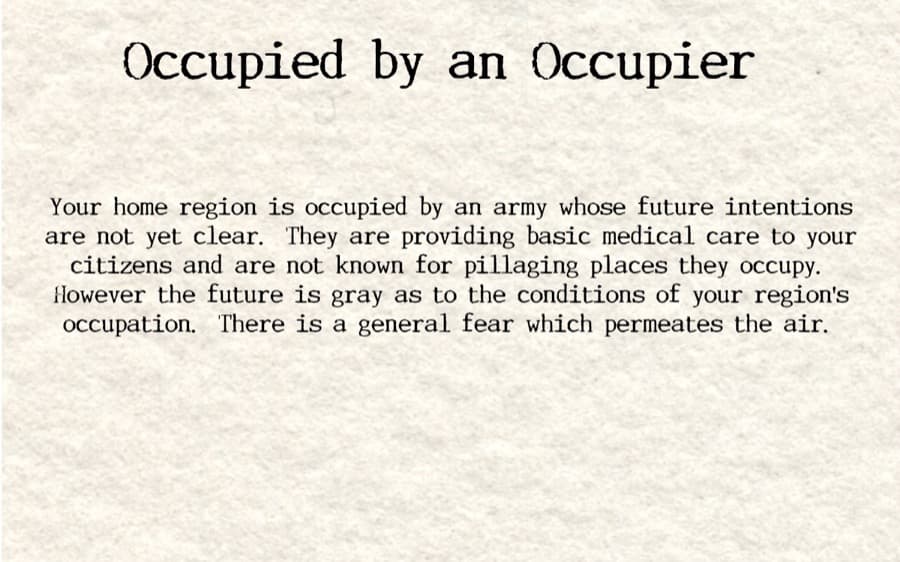
Occupied by an Occupier

Occupied by a Tyrant
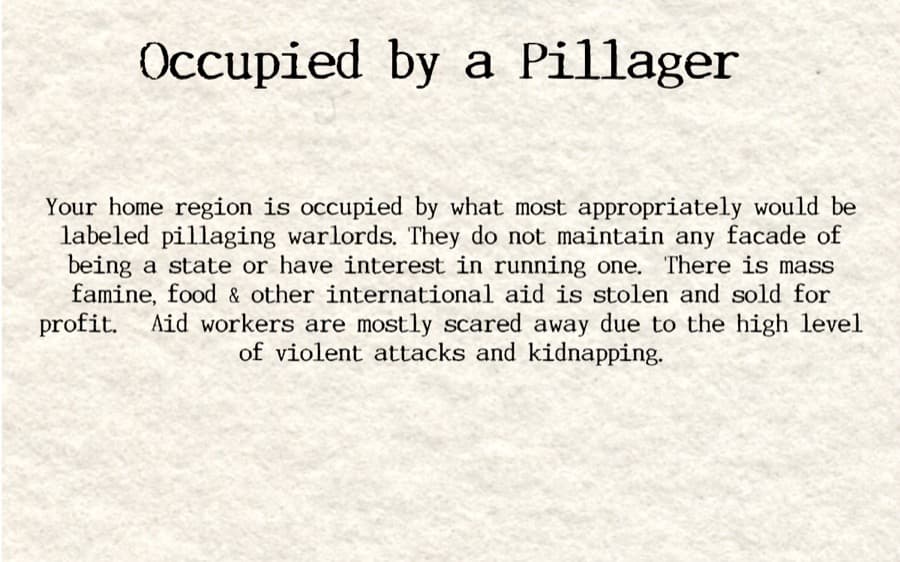
Occupied by a Pillager

The New Nation
Reach it first and the game ends immediately — for everyone. SP 125+, a full resource savings, a hospital, a university, and a clean record.

Nation in Limbo
You declared statehood and made real progress, but the game ended — someone else reached The New Nation, or the map was conquered — before you got there.
For educators
Teacher’s Guide
Built for high school & university history, geography, political science, and peace studies classes.